First day

Updated: Jun 4

The book of Acts tells us that after the risen Christ’s ascension to heaven, as instructed by Him they were all gathered together in the upper room and praying. Luke adds some details when he writes about this. After naming the eleven apostles, he says that they were praying with other women and with Mary his mother and with his brothers. Because of the mention of his mother, I believe, some church groups have understood “his brothers” to mean the children of Mary and Joseph, others to mean the children of Joseph’s first marriage, and still others to mean Jesus’ cousins.
However, I don't feel like agreeing with any of these explanations.
The next verse reads: ‘During those days when there were about a hundred and twenty brothers gathered together, Peter stood up in the midst of the brothers and said', Here, it is clear that the term "brothers" refers to the disciples. So shouldn't the same be true in the previous verse as well (1:14)? The remaining 11 apostles, the woman disciples, Mary the mother of Jesus, and then 'the other disciples' are the ones referred to. In the next verse what we see is electing someone to replace Judas, who had withdrawn himself. The condition that Peter places for this was that the one to be elected must be someone who had walked with Jesus from his baptism to his ascension. They suggested not one, but two: Matthias and Barsabbas. If they had come up with two names, at least a few such men must have been there at the time. Even here, it becomes clear that the "brothers" referred to were not Jesus' blood relatives. In chapter 20 of the Gospel of John, while the risen Lord first appears to Mary Magdalene, He says, "Go and tell my brothers." It cannot be to ‘tell his relatives’! In the next verse, John concludes the account by saying ‘she went and told his disciples’.
We see that Jesus had 72 disciples at one time. From among them, 12 were chosen to be the Apostles. Although 12 were chosen, the rest did not cease to follow him. John says that many of his disciples left him when he said, “You must eat my flesh and drink my blood” (6:66). However, John does not say that all but the 12 had left. It's evident that some still remained with him.
After Jesus’ death and resurrection, when he started to appear to his disciples, all those who had always been with him and perhaps also those who had left him for a while, must have reunited with the Apostles. The resurrection and appearances must have brought them back. I think among those who witnessed the Ascension must have been the 11 Apostles, the women disciples, Mary his mother, and some of the disciples. That means, there must have been maybe forty or seventy who witnessed, and certainly not just the 11, on the Mount of Olives. After the ascension too, as the news got spread many of the other disciples must have rejoined the group and the group must have been growing. That's how at one time there were 120! That number might have increased still. By Pentecost, it may have been two hundred or sometimes even more.
Therefore the Holy Spirit would have been poured upon not just the 12, but perhaps 120, perhaps 200! Can't we assume that when the long sermons of Peter and the others at Pentecost was over, it would have been already afternoon?! It would sound impractical for those 12 to baptize 3,000 people in the remaining half a day!
Let's reason out a step further. On that day of Pentecost, can we not assume that there were the mothers, wives, and sisters of the pilgrims who had come there from various parts of the Jewish diaspora? Could it be that the women disciples who also had received the outpouring of the Holy Spirit in the upper room did not participate in baptizing the multitudes that day? Perhaps it was for this conviction that if a priest or deacon can not make it and in a situation of danger of death the Church has always kept it open for any male or female to baptize a desiring soul. The only condition is that water should be used and the Trinitarian formula should be used, like: “I baptize you in the name of the Father, and of the Son, and of the Holy Spirit”!
Christotokos
There was a theological debate in the early Church about whether Mary should be called the Mother of Christ (Christotokos) or the Mother of God (Theotokos). In the year 431 AD, a council was convened in Ephesus. After both sides put forward their arguments in detail, the council member bishops went into voting. Since the divinity and humanity of Christ are inseparable, the majority accepted the term 'Mother of God,' as she was the Mother of the God who became man. The Church celebrates the feast of Mary, the Mother of God, on the eighth day of Christmas (January 1).
The Late Pope Francis, declared in 2018 that a feast should be celebrated of "Mary, the Mother of the Church". The feast is being celebrated on the day after Pentecost. Peter and the other apostles had only seen Jesus since his baptism which took place at the beginning of his public life. Mary, on the other hand, had known him since his birth or even from her conception.
Several Church Fathers at the Second Vatican Council had expressed their desire that a special Constitution on Mary was necessary. However, most were of the opinion that there needn't be a Marian Constitution, but that she should be included in the Constitution on the Church. This is because Mary is the most beautiful disciple, the real image of Christ. She is with the Church, and in the midst of the Church. Her Son, while hanging on the cross, entrusted her to be the Mother of the Church.
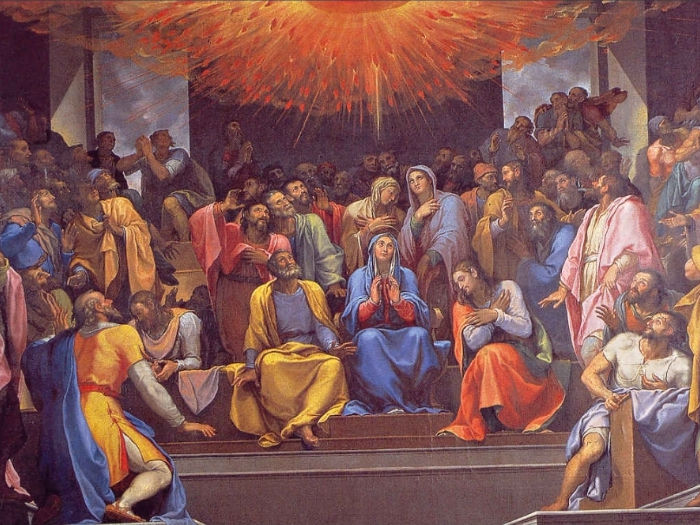
When the Holy Spirit came upon the first Christian Community gathered in the upper room on the day of Pentecost, they sat around her, the one who had received the Holy Spirit in her womb. It was with her that the first Church of about hundred and twenty or two hundred people
received the Holy Spirit!
The Church is the body of Christ. Putting it in another way, the woman who received the Holy Spirit in her womb some 33 years ago just gave birth to Christ on the Day of Pentecost!
The Christotokos!