
Mansions
- George Valiapadath Capuchin

- Dec 14, 2025
- 3 min read
A priest named Arius of the Church of Alexandria in Egypt argued that Jesus was only a man and that God had called him to Himself because of his holy life. Arius rejected the faith that had been handed over since the time of the Apostles almost two and a half centuries later. At a time when the early Church and the faith were in danger, the then Roman Emperor Constantine I summoned all the Church Fathers to Nicaea. After more than two months of discussions and meditations at the First Ecumenical Council, which brought together about two hundred bishops and more than a hundred theologians from all the churches known at that time in the Western and Eastern worlds, the Nicene Creed was formed in the year 325 AD, further explaining and expanding the Apostles' Creed. It was the same Council that unified the day of Easter in all the Churches. The rudimentary form of canon law was also created and promulgated.
Although Emperor Constantine convened them and paid for the expenses of the council, he never presided over it even for a single day. At that time, he was only a catechumen who looked upon the church fathers, bishops, priests, and theologians with great respect.
Constantine's empire extended to the European countries of present-day Italy, Portugal, Spain, France, Britain, Germany, Belgium, the Netherlands, Switzerland, Austria, Croatia, Slovenia, Serbia, Bulgaria, Macedonia, Greece, and Turkey, as well as an equal amount of territory in Asia, the Middle East, and Northern Africa. The city of Rome in Italy was certainly at a corner of Europe. Strategically as well as practically it wasn't wise to keep the capital of the empire in Rome. Therefore he decided to rebuild the last city in the border of Europe to be the Capital of his empire. It was the point where Europe and Asia met. Through Asia, he could easily maintain his influence and control over the territories under his control in Africa. Thus, he named the new capital city he built Constantinople after himself. Over time, the locals shortened the long name Constantinople to mean 'city center' and called it 'Istanbul'.
Emperor Constantine built two large mansions in the center of the city of Constantinople that he built. His large palace, which offers a beautiful view of the Sea of Marmara, the bay between the Mediterranean Sea and the Black Sea, and about three hundred meters to the left of the palace, he built the huge church of Hagia Sophia or "Megale Ekklesia" (Great Church). As was the custom, he built it entirely of wood. This original church was destroyed by fire in 404.
Because it is the land where much of the history of the early Church got unfolded, all the recent popes had got to go to Turkey. Pope John XXIII was the Apostolic Delegate to Turkey for ten years. After him Pope Paul VI in 1967, Pope John Paul II in 1979, Pope Benedict XVI in 2006, Pope Francis in 2014, and Pope Leo IX in 2025. The late Pope Francis himself had planned a second trip to Nicaea, Turkey, to mark the 1700th anniversary of the Nicene Creed. The new date for the visit was set after his death and the election of a new Pope. Incidentally, Pope Leo's first foreign visit happened to be to Turkey, marking the 1700th anniversary of the Creed, which is accepted and followed by the East and West Catholic Churches, Orthodox Churches, and the major Protestant Churches.
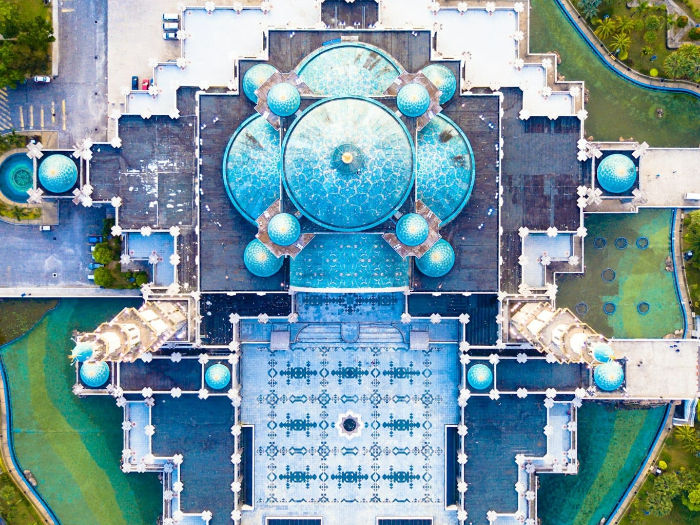
History has it that the first Hagia Sophia was destroyed by fire in 404 and then was rebuilt in 415 and was burned down again in 532. It was in the context of the two destructions by fire that Emperor Justinian I built the new Hagia Sophia in stone in 537 on the very same site as the old Hagia Sophia. More than a thousand years later, in 1609, the first emperor of the Ottoman Empire, Sultan Ahmed I, built the magnificent 'Blue Mosque' on the site of the palace of Emperor Constantine, which was meant to surpass Hagia Sophia in beauty and grandeur. Although there was a lot of controversy surrounding the Pope's visit to the Blue Mosque, the visit turned out to be one of importance because of the direction it seems to be indicating.
(To be continued)


