
The temple built by Solomon in cedar was modeled after the tabernacle, the tent of meeting, which Moses had built at God’s command, but was twice or more in size.
In both the tabernacle and the temple, the things enshrined in the Holy Place (Kodesh) and in the Holy of Holies (Kodesh HaKodeshim), were the same.
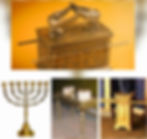
What was being enshrined in the Holy of Holies? The Ark of the Covenant, the symbol of the Most Holy Presence (Shekinah), was a wooden box about two and a half feet high and wide, and three and a half feet long (about the size of our small writing desk). It had poles on either side for the priests to carry it on their shoulders. It was made of acacia wood. The whole thing was covered with gold. The top lid of the box was also called the mercy seat. I believe that the idea was that God was being seated on top of this box. The figure of two cherubim angels made of gold sheets, facing each other, was created on the top of the box - on both ends of the mercy seat. Their wings were touching each other above their heads, casting a shadow on the mercy seat.
Now, what was preserved inside this ark of the covenant (the box)?
There were three objects in it.
1 The tablets of the covenant - or the stone tablets on which the Ten Commandments were written which God had given through Moses
2 The bread of the desert journey called 'manna', which Aaron collected and sealed in a golden jar as instructed by God through Moses
3 Aaron's rod that miraculously blossomed
Why were these three objects? It can be said that God's special intervention was visible in all three objects.
All three objects point to the God of the Exodus; To the covenant.
I think there is another way to approach this. The Ten Commandments are the law. At the same time, they are also the word of God. Aaron was the first high priest appointed by God. His miraculously blossomed staff was symbol of God's selection of him. In short, Aaron's staff that blossomed, buried in the Ark of the Covenant, is a symbol of the priesthood itself.
An omer (about two liters) of 'manna', a bread preserved in a golden jar, is a symbol of God's Providence during the desert-journey. In the morning, the Jewish people saw a white substance lying on the sand of the desert and asked - "What is this?" From that question of surprise and amazement comes "manna"!
Seemingly, the Law/Word of God, the Bread that came down from heaven, and the holy priesthood - these are the three most holy relics of the Old Testament times.
Now, what was in the Holy Place outside the Curtain?
Again, there were three things.
1 On the right side was the seven-branched golden lampstand called the Menorah
2 The weekly showbread on the gold-covered table.
3 The daily incense offered by the priests on the gold-covered altar of incense.
What was outside was the copy of what was inside. Moses first received God's revelation while he was tending the sheep of Jethro in Midian. It was there that God called Moses, gave him a mission, and revealed himself as 'Yahweh'. In short, the source of the first Word of God was a burning but unburnt bush. If you look closely, the seven-branched lampstand called the Menorah is the representation of the burning bush.
The 12 showbreads were brought to the Lord from the twelve tribes of the Hebrews. Again the symbol of God's Providence.
The incense offered on the altar of incense was done by the priests to represent the worship to and prayer before God.
In short, the Law/Word of God that is still burning, the Providence of God that is still in operation, and the priesthood that still exists- are the representations in the Kodesh.
The New testament and the Church teach that Jesus summed up or integrated all the three into Himself: the Law/the Word, the Bread, and the Priesthood.
Related Posts


Add a Title
Add a Title
Add a Title
Add a Title
Change the text and make it your own. Click here to begin editing.
Add a Title
Add a Title
Add a Title
Add a Title
Change the text and make it your own. Click here to begin editing.
Add a Title
Add a Title
Add a Title
Add a Title
Change the text and make it your own. Click here to begin editing.


